
Join in the Constable 250 Celebrations at Burgh House
JOHN CONSTABLE IN HAMPSTEAD
Thursday 11th June – Sunday 20th September 2026
Burgh House, New End Square, London, NW3 1LT
Admission Free
Social Media @burghhouse1704
Website www.burghhouse.org.uk
To celebrate the 250th anniversary of the birth of iconic Suffolk-born artist John Constable, Burgh House is delighted to present John Constable in Hampstead, a new exhibition exploring the artist’s profound connection to Hampstead Heath and the surrounding area where he lived and worked for almost twenty years.
Opening on 11th June, the anniversary of Constable’s birth, John Constable in Hampstead brings together key works from the artist’s Hampstead years, revealing how the area became both a creative inspiration and a refuge from London life. Through rarely seen paintings, mezzotints, portraits, and personal letters, this exhibition traces Constable’s deep engagement with the landscape, weather, and people of Hampstead during a pivotal and deeply personal period in his life.
Constable first came to Hampstead in 1819 with his wife, Maria Bicknell, whose worsening tuberculosis prompted the family to seek the healthier air of the Heath. The Constables later settled permanently at 6 Well Walk (now 40 Well Walk), just moments from Burgh House, where Maria died in 1828, leaving Constable widowed with seven young children.
Constable used his time in Hampstead to sketch and study the natural world, producing some of his most celebrated ‘Cloud Studies’ alongside rural scenes inspired by the Heath and its surrounding landscape. Fascinated by changing weather conditions and atmospheric effects, he used the open skies to observe shifting clouds with remarkable immediacy and scientific curiosity. The exhibition explores how these studies informed the dramatic cloudscapes and emotional intensity of his later paintings.
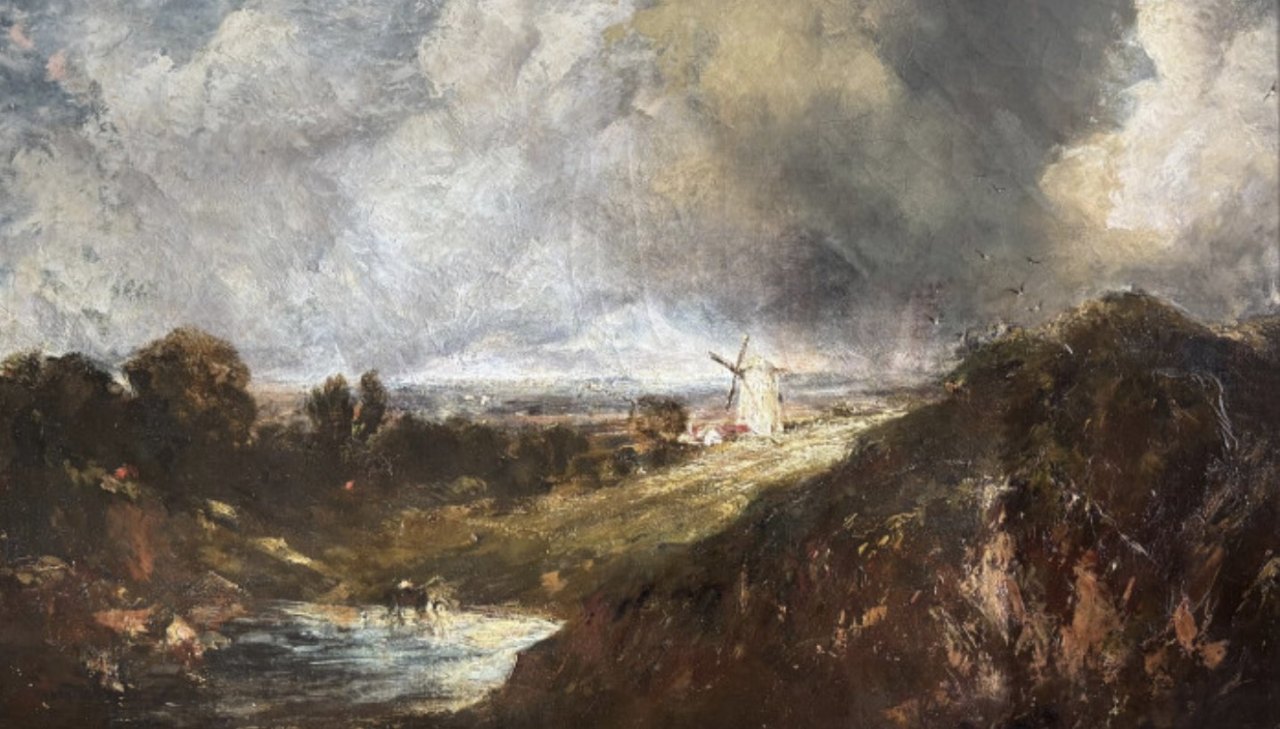
A highlight of the exhibition is an oil study for Hampstead Heath with a Rainbow (c.1830), on loan from a private collection. Depicting Branch Hill Pond — one of Constable’s favourite Hampstead views — the painting captures the brewing storm clouds and luminous atmosphere that define his mature style. Technical analysis has revealed an unfinished portrait beneath the landscape, thought to depict Constable’s uncle, the wine merchant David Pike Watts.
The exhibition also examines Constable’s important collaboration with the printmaker David Lucas. Between 1830 and 1832, the pair produced the celebrated mezzotint series English Landscape Scenery, translating Constable’s paintings into richly atmospheric prints. Several rare mezzotints from the series — including views of Hampstead Heath and two recent acquisitions to the Burgh House collection made possible through kind donations from Burgh House Trustee, Frances Carey in memory of David Bindman (1940-2025) and Henry Gerrish of Gerrish Fine Art.
Alongside landscapes, the exhibition features portraits and letters connected to Constable’s close friend Dr Herbert Evans, who cared for Maria during her final illness and supported the artist after her death. Also on display is a portrait of Dr Evans’s mother, Deborah Mescall Evans, accompanied by a letter describing her experience of sitting for Constable.
Constable’s final visit to Hampstead took place in 1836, when he delivered a lecture on landscape painting at the Assembly Rooms in Holly Hill. He died suddenly the following year in his London studio and is buried at St John-at-Hampstead beside his wife and six of their children.
On Thursday 30th July, Assistant Curator Helen Woollison will present a special talk exploring Constable’s life and artistic practice in Hampstead. Marking the 250th anniversary of the artist’s birth, this event will also offer visitors the opportunity to view the exhibition, including the rare oil study for Hampstead Heath with a Rainbow, currently on loan to Burgh House from a private collection.
Curator of Burgh House, Amy Miller, comments: “John Constable’s years in Hampstead were among the most creatively rich and emotionally significant of his life. The Heath offered him both inspiration and solace, shaping some of his most experimental and atmospheric works. This exhibition reveals not only Constable’s extraordinary observation of the natural world, but also the deeply personal connections he formed within Hampstead itself. We are delighted to bring together works and archival material that shed new light on this important chapter of his career.”
Moira Lascelles, Burgh House’s newly-appointed Director, comments: “John Constable’s connection to Hampstead forms an important part of both the artist’s legacy and the area’s cultural history. We are delighted to mark this major anniversary with an exhibition that brings together rare works, personal stories and remarkable landscapes, while continuing Burgh House’s mission to celebrate Hampstead’s artistic heritage.”
About Burgh House
Burgh House is a Grade I listed Queen Anne house built in 1704, located in the heart of Hampstead Village in North London. A residence until the 1930s, Burgh House is now a self-funding charity that acts as a cultural hub bringing together heritage, art and community programming. Burgh House is an Arts Council England accredited museum with a permanent collection of works that relate to Hampstead. It is open free of charge to the public four days a week Wednesday – Friday and Sunday, 10am-4pm.
About John Constable
John Constable was born at East Bergholt, Suffolk, the son of a corn and coal merchant and farmer. He devoted much of his life to painting the local landscape, the scenes of his ‘careless boyhood’ which, he said, ‘made me a painter’ (in R.B. Beckett, ed., John Constable’s Correspondence, VI, Ipswich 1968, p.78). He went to work for his father in the family business about 1792. In 1794 he made a sketching tour of Norfolk. He made his first etchings in 1797. In 1799 Constable was introduced to Joseph Farington, RA, and entered the Royal Academy Schools. He visited Staffordshire and Derbyshire in 1801. He first exhibited at the Royal Academy in 1802. He received a commission in 1805 to paint an altarpiece for the church at Brantham. He toured the Lake District in 1806. In 1810 he began work for an altarpiece for Nayland Church.
Constable exhibited regularly at the British Institution from 1808, at the Liverpool Academy 1813-14, at the Birmingham Society of Arts from 1829, and at the Worcester Institution 1834-6. He was made an Associate of the Royal Academy in 1819, and a Royal Academician in 1829. The Hay-Wain (1820-1, National Gallery, London) was one of three of his works shown at the Paris Salon in 1824 and earned him a gold medal from Charles X. In 1826 he was awarded a gold medal by the Society of Fine Arts, Lille, France, following exhibits at its Salon.
Yo



Johannes Radebe Finally Home
Finally Home is your chance to celebrate with JoJo at the biggest party in town.
Read More →