
Dr. Edward Harrow had spent twenty years studying the lives of forgotten men. Ancient kings, disgraced nobles, and long-dead warriors filled the shelves of his London study. Yet no figure fascinated him more than the Scottish patriot William Wallace.
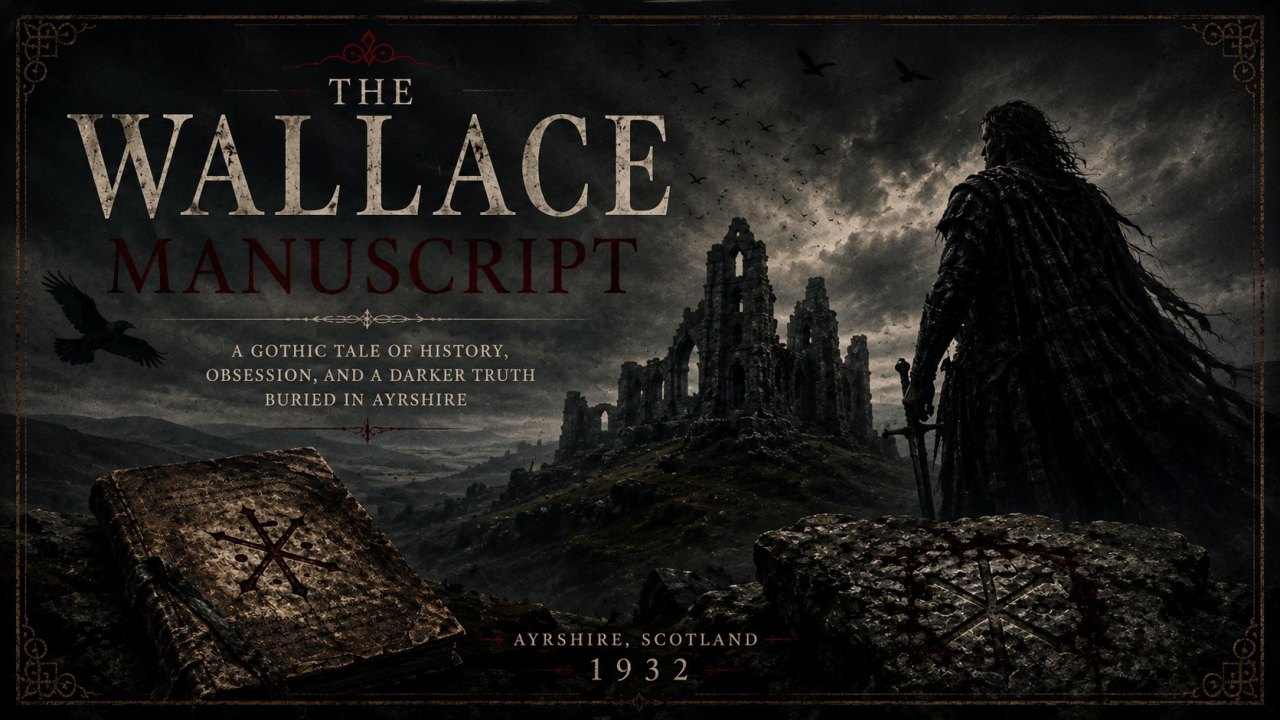
In the autumn of 1932, Harrow travelled north to Ayrshire. Rumours had reached him of a sealed chamber beneath the ruins of an old abbey, a place said to contain documents hidden since Wallace’s time. Local villagers dismissed the stories with uneasy smiles and warnings to leave the dead alone.
Harrow paid no attention. The abbey stood on a lonely hillside overlooking a mist-covered valley. Its crumbling stones were blackened by centuries of rain. Ravens nested among the broken arches. On his third day of excavation, Harrow discovered a concealed staircase beneath a fallen altar. Lantern in hand, he descended. The air below was damp and foul. At the bottom lay a small chamber lined with shelves. Most had collapsed into dust, but one iron-bound chest remained untouched. With trembling hands, Harrow forced it open. Inside rested a manuscript wrapped in rotting leather. The pages were covered in Latin. As the historian translated them, a terrible unease settled over him. The manuscript was not a chronicle. It was a confession. According to its anonymous author, Wallace had not merely fought for Scotland. In the forests of Ayrshire, he had encountered something ancient—a being that dwelt beneath the earth long before men built castles or churches. The text described a cavern hidden beneath the hills, where Wallace and his companions sought refuge after a battle. There they found a vast black pit descending beyond sight. From its depths came whispers in no human language.
Several warriors fled immediately.
Others went mad.
The confession claimed Wallace descended alone.
When he returned, he carried a strange sword marked with symbols no scholar could identify. His victories thereafter were attributed not to courage or skill, but to a bargain struck in darkness. Harrow laughed at the absurdity. Then he reached the final pages. There, sketched in faded ink, was the symbol supposedly engraved upon Wallace’s sword. The historian froze. The same symbol was carved into the stone wall beside him. Freshly. As though etched only days before. A cold wind swept through the chamber. The lantern flickered. Then came the whisper. It was faint at first, like distant speech carried by water. Harrow turned slowly. Behind the shelves stood a narrow passage he had not noticed before. The whisper came from within. Against every instinct, he approached. The tunnel twisted downward for what seemed like miles. The walls grew smoother, less natural. At last he emerged into a colossal cavern. His lantern light vanished into darkness.
Then he saw it. The pit. Exactly as described in the manuscript. A vast circular abyss. And from its depths rose thousands of pale faces. Not living faces. Not dead ones either. They stared upward with hollow eyes, their mouths moving in silent prayer. Among them stood one figure taller than the rest. A warrior. His armour rusted. His cloak torn by centuries. Yet Harrow recognised him instantly from countless portraits.
William Wallace.
The warrior slowly raised his head. His eyes opened. They were completely black. A voice echoed from the abyss. “The bargain endures.” The cavern shook. The lantern shattered. Darkness swallowed everything.
Weeks later, search parties found the abbey abandoned. No trace of Dr. Harrow was ever discovered. Only his notebook remained. On its final page, written in frantic, trembling script, were six words:
“Wallace did not die in London.”
“Something else returned instead.”